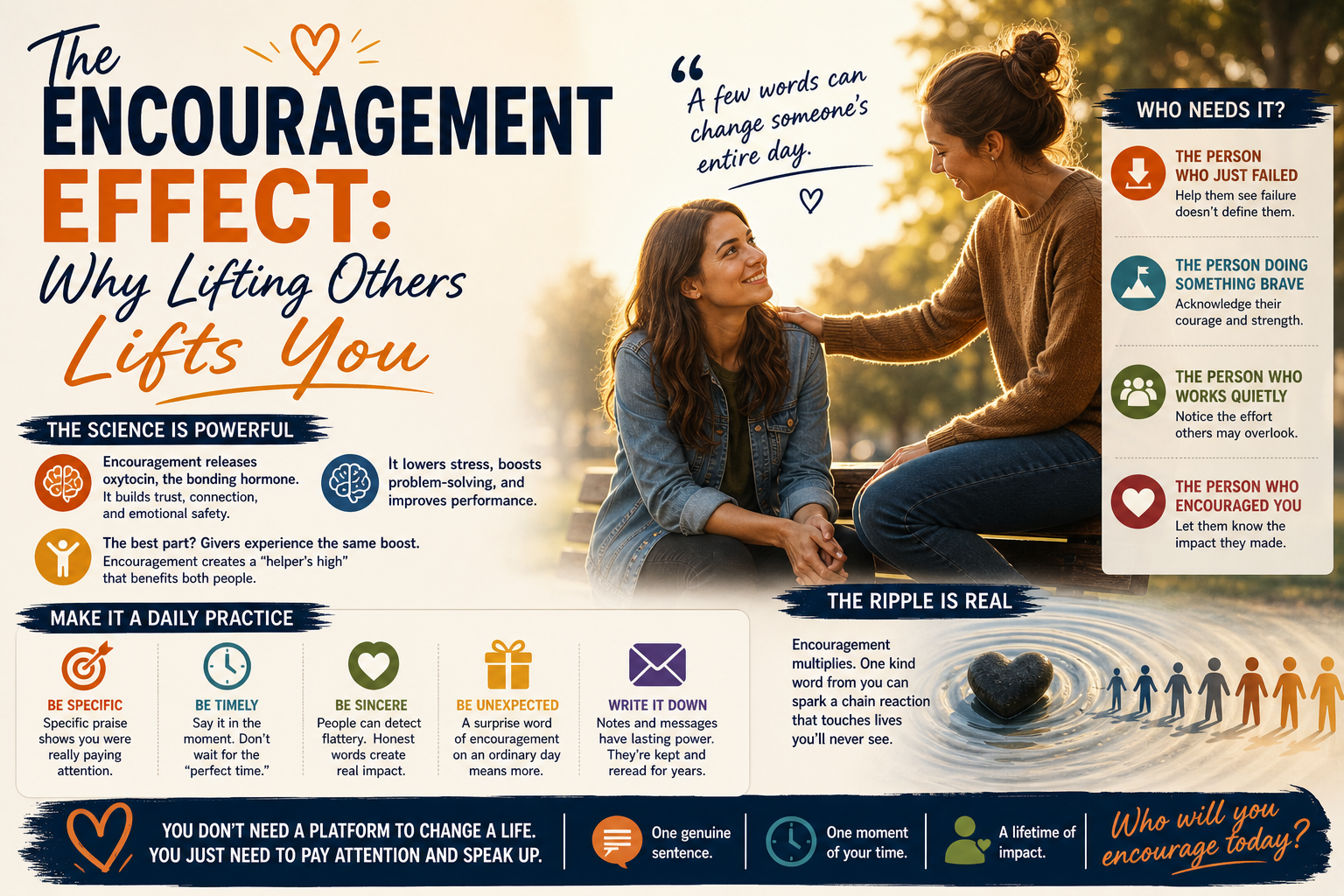
The Encouragement Effect: Why Lifting Others Lifts You
When was the last time someone said something that changed your entire day?
Not a grand gesture. Not a life-altering speech. Just a few honest words "You're doing a great job," "I noticed how hard you're working," "I'm glad you're here" that landed at exactly the right moment and shifted something inside you.
Now ask yourself: When was the last time you were that person for someone else?
Encouragement is one of the most underrated forces in human life. It costs nothing, takes seconds, and has the power to redirect someone's trajectory. And yet most of us are staggeringly stingy with it.
The Science of Encouragement
Encouragement isn't just a nice thing to do. It's neurologically potent and that includes the way you speak to yourself. Internal encouragement your self-talk has just as powerful an effect on your brain and behavior.
When someone receives genuine encouragement, their brain releases oxytocin, the bonding hormone associated with trust, connection, and safety. Cortisol, the stress hormone, decreases. The prefrontal cortex, responsible for problem-solving and creative thinking, becomes more active.
In other words, encouragement doesn't just make people feel better. It makes them think better. It literally changes their brain chemistry in ways that improve performance, decision-making, and resilience.
And here's the remarkable part: the person giving the encouragement experiences nearly identical neurological benefits. The act of lifting someone else activates the same reward pathways as receiving a gift. Psychologists call this the "helper's high" and it's as real as any pharmaceutical intervention.
Encouragement is one of the rare human actions where the giver and the receiver both wins.
Who Needs It?
Everyone. Without exception.
But let me get specific, because "everyone" is too vague to act on.
The person who just failed. They're replaying their mistake on an internal loop, questioning their competence, and wondering if they should quit. A word of encouragement doesn't erase the failure, but it can keep them from making the failure their identity.
The person who's doing something brave. Starting a business. Leaving a toxic relationship. Going back to school at 45. Changing careers. These decisions are terrifying, and the courage required is enormous. Acknowledgment from someone else makes the fear a little more manageable.
The person who works quietly. In every family, workplace, and community, there are people doing essential work that nobody notices. The coworker who keeps things organized. The parent who shows up relentlessly. The volunteer who does the unglamorous tasks. These people rarely hear "thank you" and they need it the most.
The person who encouraged you. Mentors, teachers, coaches, and friends who lifted you up often don't know the impact they had. Tell them. A message that says "You changed my life" costs nothing and means everything.
Why We Hold Back
If encouragement is so powerful and so easy, why don't we do it more?
Three reasons:
We assume people already know. They don't. The coworker you admire probably doesn't know you admire them. The friend whose courage impresses you probably feels terrified. The parent doing a great job probably feels like they're barely surviving. What's obvious to you is invisible to them.
We feel awkward. Our culture doesn't always make it easy to express genuine praise. It can feel vulnerable, overly emotional, or performative. But the discomfort you feel for five seconds is worth the impact it creates for days.
We're too focused on ourselves. This isn't a moral failing it's just human nature. We're wired to attend to our own survival, our own problems, our own goals. Encouraging others requires us to look outward, which takes intentional effort.
Making It a Daily Practice
If your inner voice tends to be more critical than encouraging, learning how to reshape that internal dialogue can make everything else EASIER.
Challenge yourself to encourage at least one person every day. Here's how:
Be specific. "Good job" is nice. "I noticed how patiently you handled that difficult customer — that was impressive" is transformative. Specific encouragement tells someone you were actually paying attention, which amplifies its impact tenfold.
Be timely. Encouragement is most powerful in the moment. Don't wait for the annual review, the birthday card, or the "right time." If you notice something worth acknowledging, say it now.
Be sincere. People can detect flattery. Encouragement works because it's honest. If you don't mean it, don't say it. But if you notice something genuinely good say it even if it feels small.
Be unexpected. A text that says "I was thinking about you and wanted you to know I appreciate you" can arrive on an ordinary Tuesday and become the best thing that happened to someone all week. The surprise amplifies the impact.
Write it down. A handwritten note, a thoughtful email, or even a short message has staying power that spoken words don't. People keep encouraging notes for years. They reread them on hard days. Your written words might carry someone through a season you'll never know about.
The Ripple
Here's the final, beautiful truth about encouragement: it multiplies.
It starts with how you speak to others, and to yourself. If you want to strengthen that internal voice, you can begin HERE:
The person you encourage today is more likely to encourage someone else tomorrow. That person encourages another. The ripple extends far beyond your view, touching lives you'll never meet, in ways you'll never know.
You don't need a platform, a degree, or a title to change someone's life. You just need to pay attention and speak up.
One genuine sentence. One moment of your time. That's all it takes.
Who needs encouragement today? Look around. They're closer than you think.