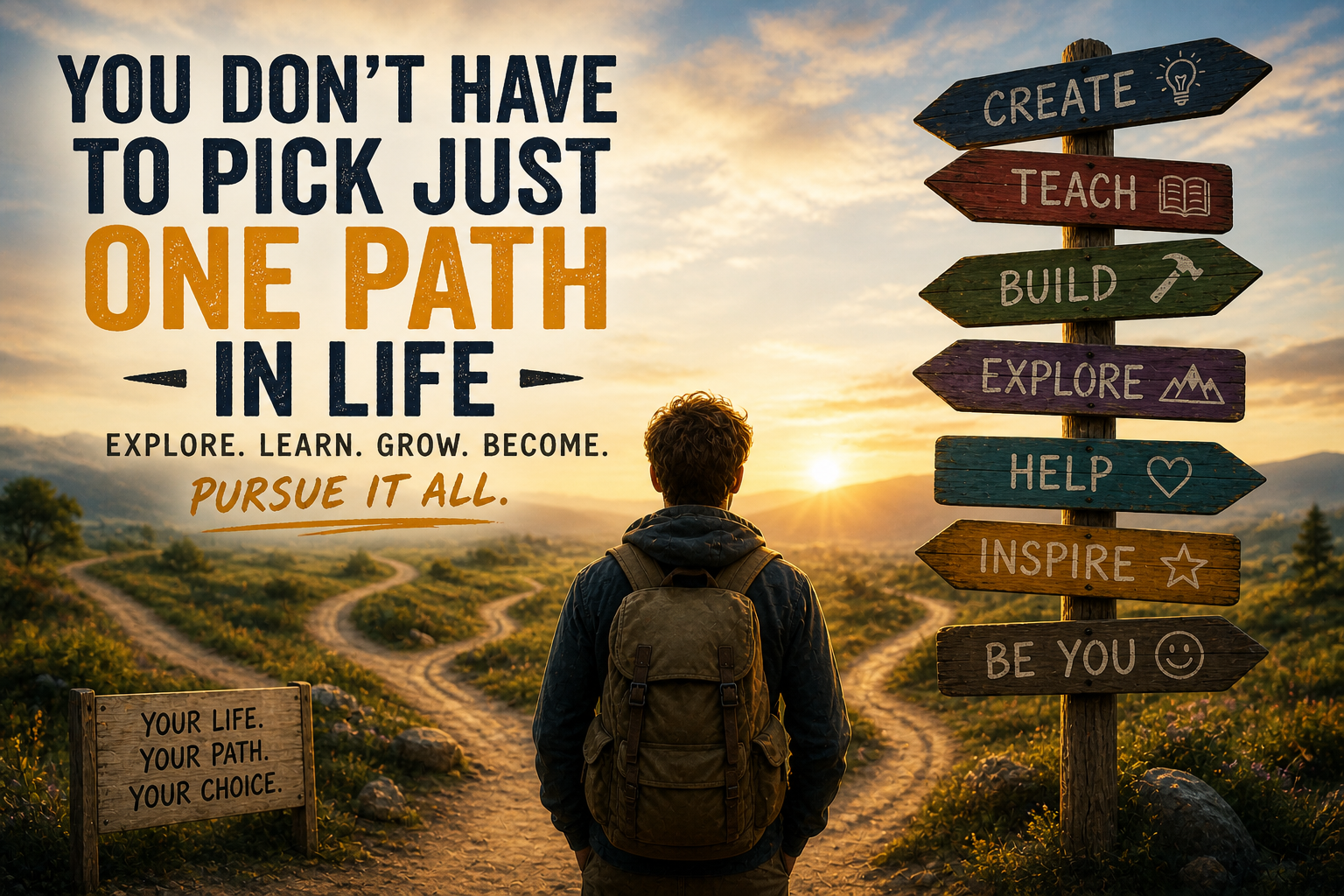
You Don't Have to Pick Just One Path in Life
Somewhere along the way, someone told you to pick one thing and stick with it.
Choose a major. Choose a career. Choose your lane. Be a specialist. Find your niche. Don't be a jack of all trades, because as the saying goes, you'll be a master of none.
This advice sounds responsible. It sounds practical. And for some people, it's exactly right.
But for the rest of us the ones who light up at new ideas, who can't imagine doing the same thing for forty years, who have twelve tabs open in their browser and five half-started projects on their desk this advice isn't wisdom. It's a cage.
What if the most fulfilling life isn't the one where you pick a single lane? What if it's the one where you give yourself permission to explore every road that calls to you?
The Myth of the Single Calling
The concept of a single life purpose is relatively modern and largely Western. For most of human history, people wore multiple hats by necessity. The farmer was also a carpenter, a healer, a storyteller. Leonardo da Vinci was a painter, inventor, anatomist, engineer, and musician. Benjamin Franklin was a printer, scientist, diplomat, and writer.
Nobody told them to "pick one thing."
The industrial age created specialization, and specialization created the expectation that your identity should be reducible to a single job title. "What do you do?" became the first question we ask at every gathering and we expect a simple, clean answer.
But humans aren't simple or clean. We're curious, multifaceted, and wired to explore. The person who wants to teach and build furniture and write poetry and learn coding isn't scattered. They're fully alive.
The Multi-Potentialite Advantage
Emilie Wapnick coined the term "multipotentiality" to describe people with many interests and creative pursuits. And she made a compelling case that these people have distinct advantages:
Idea synthesis. When you have knowledge across multiple domains, you can connect ideas that specialists miss. Innovation almost always happens at the intersection of fields, not within a single one. The person who understands both technology and art create things that neither a pure technologist nor a pure artist could.
Rapid learning. People who frequently learn new skills develop the meta-skill of learning itself. They know how to absorb information quickly, identify patterns, and reach competency faster. Each new pursuit builds on the learning infrastructure of the last.
Adaptability. In a world where entire industries can be disrupted in a decade, the ability to pivot is priceless. The person with one narrow skill set is vulnerable. A person with a diverse portfolio of abilities can adapt to almost anything.
“But How Do You Make Money?" Question
Let's address the practical concern, because it's valid. You need to pay rent. You need stability. Pursuing multiple interests sounds great in theory, but does it work financially?
Yes, if you're strategic about it.
The most effective approach is what I call "sequential depth." You don't pursue fifteen things simultaneously with shallow attention. You go deep into one area for a season long enough to develop real competence and potentially generate income then you carry those skills forward as you move into the next area.
A graphic designer who learns copywriting becomes a more valuable creative professional. A teacher who learns data analysis opens doors in educational technology. A nurse who writes becomes a health content expert.
Each pursuit doesn't replace the last. It enhances it. Your unique combination of skills becomes your competitive advantage, a stack that no one else has.
Here's what nobody tells you: you're allowed to change your mind. You're allowed to outgrow a career. You're allowed to discover, at 35 or 50 or 65, that you want to do something completely different.
The sunk cost fallacy "I've already invested so much in this path" is one of the most effective traps for keeping people miserable. Time you've already spent isn't a reason to spend more time doing something that no longer fits.
Your past experiences aren't wasted when you change direction. They become the foundation for whatever comes next.
Living the Portfolio Life
The "portfolio life" a term gaining traction among career researchers describes a life built from multiple income streams, projects, and purposes rather than a single job. In 2026, this isn't just possible. It's increasingly normal.
Technology has made it easier than ever to monetize diverse skills. The freelance economy, digital products, online teaching, consulting, and content creation have created pathways that didn't exist a generation ago.
You can teach yoga in the morning, write code in the afternoon, and work on your novel at night. You can consult in your area of expertise three days a week and volunteer in a completely different field, the other two.
The question isn't "Can I have it all?" The question is "Am I willing to design a life that reflects all of who I am?"
The Permission You've Been Waiting For
If you've been carrying guilt about your inability to choose one thing let it go.
Your curiosity isn't a weakness. Your varied interests aren't a lack of focus. Your desire to do many things isn't a character flaw.
It's one of the best things about you.
Who said you have to pick one thing? Who made that rule?
Nobody who was paying attention to how remarkable and multifaceted you really are.
Pursue it all. Maybe not all at once. But definitely all in one lifetime.
You plan to live a while, don't you?

Explore Online Health, Fitness, and Career Courses
Looking for flexible online learning in health, fitness, wellness, business, IT, or career development? Academy for Health & Fitness offers self-paced courses designed to help learners build practical skills from anywhere.
View Courses at Academy for Health & Fitness